

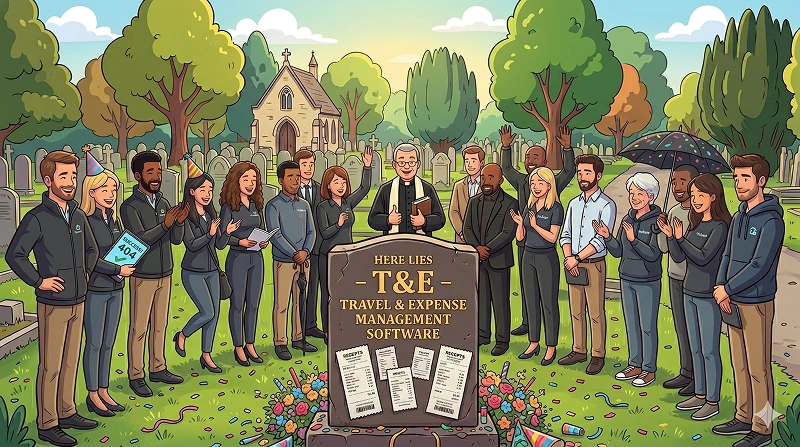
There’s a version of this announcement where we tell you about a new product, list its features, and invite you to book a demo. This isn’t that.
What we’re announcing today is the result of a different question. Not “how do we build a better T&E platform?” but “why does T&E exist as a thing people have to manage at all?”
The category solved the wrong problem.
Expense management became a software category in the 1990s when finance teams needed a way to collect receipts and reimburse employees. Concur automated the paper process. Modern tools made it faster, smarter, mobile. We made ours global.
But every one of these products – ours included – was built around the same core assumption: the mess exists, and we’re here to help you process it.
File an expense. Chase a receipt. Reconcile at month-end. The entire category is infrastructure for a failure state.
What nobody asked was: why is the mess there in the first place?
The mess is a context problem.
Here’s what actually happens when an employee goes on a trip. They book a flight through one system. Hotel through another. Take an Uber, pay with a personal card. Have a client dinner, put it on the corporate Amex. The transactions happen in four different places. Each one arrives downstream as a data point without a story.
That dinner receipt isn’t just a dinner receipt. It’s a client meeting, on a Tuesday, in a city the employee flew to that morning, on a trip that’s already 12% over budget. But to every system that received it, it looks like a $94 charge from a restaurant in Chicago.
So finance chases context manually. A human reconciles what should have been automatic.
The receipt was the easy part. Understanding it was always the real work.
Processing transactions is automation. Understanding them is something else entirely.
The timing is no longer theoretical.
For years, this was a problem worth solving eventually. Finance teams were stretched, month-end was painful, but it was manageable. Humans were in the loop.
That’s changed.
AI agents are now booking travel autonomously. Rebooking cancelled flights at midnight. Issuing virtual cards for last-minute expenses. Every major organization we talk to is either deploying or evaluating agents that take financial actions without a human in the approval loop at the moment of action.
Here’s the problem: every governance framework in existence was designed for people. Your travel policy assumes a person chose the flight. Your approval workflow assumes someone clicked “submit.” Your audit trail assumes a human made a decision.
When an agent acts, none of that applies.
The question isn’t whether to use agents. That decision has largely been made. The question is what governs them – and whether the answer is the same layer that governs your people, or a different one for each tool that gets deployed.
The industry’s answer has always been: own the channel.
Every major platform in T&E is built on the same thesis. Control where people book, and you control what you can see. Control what you see, and you can deliver governance.
It’s a logical model. It has a structural ceiling.
According to Deloitte’s 2025 study, only 18% of business travelers book all travel through their company’s designated platform. Even with strong tools, even with mandates, employees book through consumer apps, call hotels directly, use personal cards. Every booking that happens outside the platform is invisible.
The answer from every platform in the market is the same: push adoption harder. More restrictions. More friction for anyone who goes off-platform. Higher walls.
What if the answer was to build something that didn’t need the walls?
Intelligence at the transaction level. Not the booking level.
This is how we see the world.
Policy, governance, and context don’t have to live inside the booking channel. They can live at the layer beneath every transaction – so they work the same whether the booking came from a corporate TMC, a consumer app, or an agent that acted while everyone was asleep.
When you build at the transaction layer, a few things change. An employee who books through a preferred platform and one who books on a consumer OTA land in the same governance framework. An agent and a human employee follow the same rules. A trip booked three weeks out and a last-minute rebook get the same treatment.
The channel doesn’t determine the visibility. The intelligence does.
Today, we’re introducing the Orchestration Layer.
The Orchestration Layer is the intelligence infrastructure we’ve been building toward. It connects every booking platform, payment network, and card program into a single layer that already understands the context behind every transaction – from calendar invites and org charts to policy thresholds and GL codes.
When a transaction happens anywhere, the layer understands it before anyone has to ask. Policy is enforced at the moment of action. GL codes are assigned automatically. Anomalies are caught before they reach the books. Agents follow the same governance as employees. And for global organizations, this happens across every entity, currency, and region simultaneously.
This is what makes invisible T&E possible. Not a walled garden where everything must flow through one platform. A foundation that connects to everything and turns fragmented signals into complete understanding.
Month-end that already happened. Exceptions only. Nothing left to chase.
The best T&E doesn’t need a better UI. It needs to disappear.
Today, that stops being theoretical.
-
Get the latest blogs from Mesh by subscribing to our newsletter
Manage Your Payments With Full Control & Visibility